
The Composition Formerly Known as Chaos
how a wide lens, a remote camera, and a bit of luck helped capture the moment.

Sometimes a photograph is built carefully. Sometimes it is simply survived. And occasionally, if things line up just right, it becomes something closer to choreography, especially when a game is tied and the clock nearly gone.
Michigan found one last look, a three that dropped, and sealed a 68–65 win over Wisconsin. This is about two photographs from a single moment. Or perhaps, deux petits instants1 inside the same play.
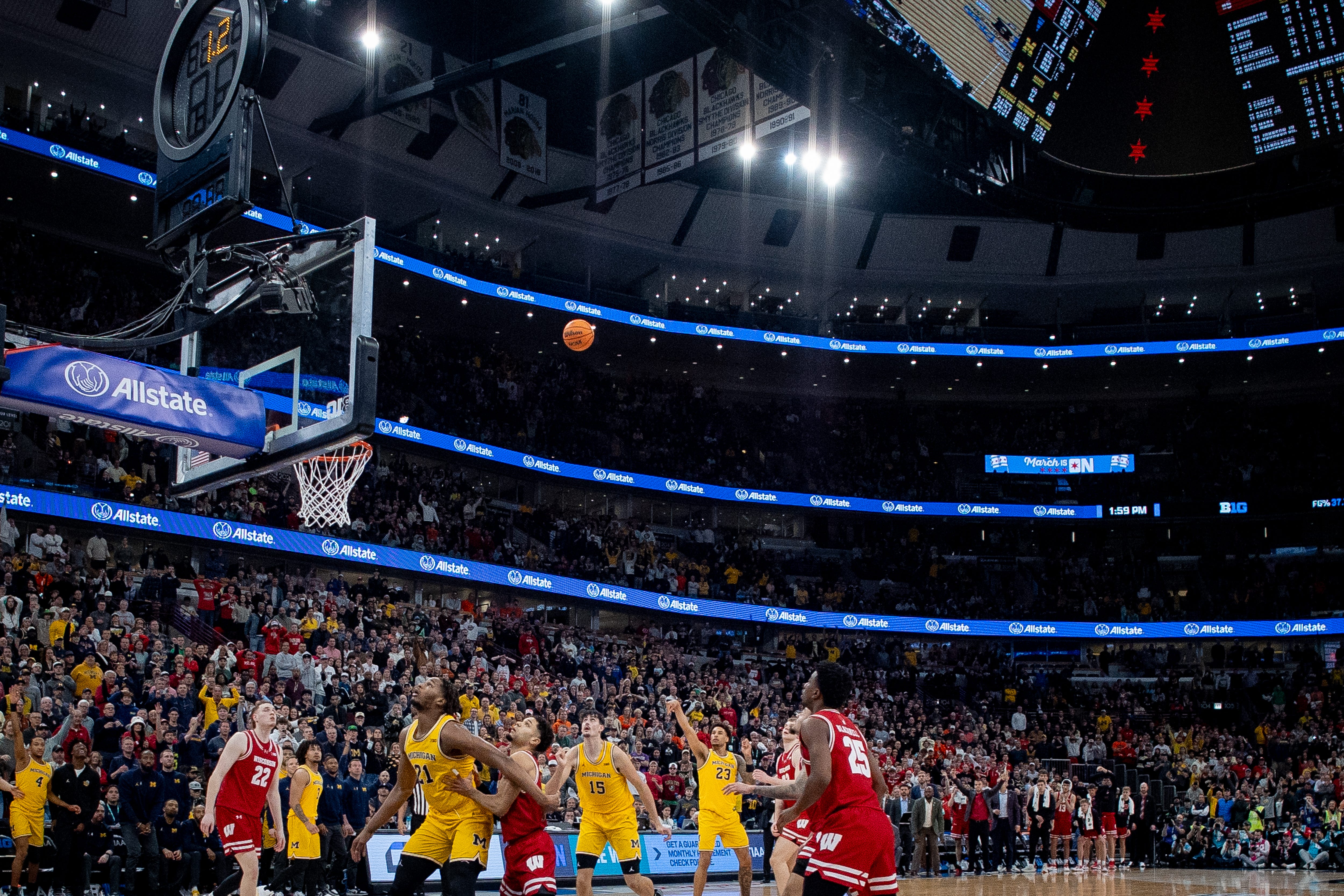
This first frame sits somewhere in between.
The composition works because everything converges toward the ball. Heads tilt upward, bodies lean, arms extend. For a brief fraction of a second ten players, including the shooter Yaxel Lendeborg, and twenty thousand people share the exact same point of attention. The eye follows them instinctively.
It creates something that feels oddly classical. Almost like a Baroque painting where every figure is oriented toward the same object, the same moment of tension. The ball becomes the focal point, suspended above the scene, while the players form a loose triangle beneath it. Painters have used that structure for centuries because it guides the eye naturally.
Of course, you cannot actually choreograph people like that.
What you can do is choose the stage.
During the timeout just before the final possession, I swapped to a wide angle lens (Canon RF 16mm). I had the feeling the game would likely come down to one basket. One possession. One shot. A tighter lens would have given me a cleaner celebration. But going wide offered something else. The entire moment:
The arena - The crowd - The scale of it all.
It is a gamble. You trade intimacy for grandeur2. You risk missing the celebration entirely. Which, to be honest, I did. But I also knew the other excellent photographers around me would grab that part. C’est la vie3. That is the quiet advantage of working side lines full of talented colleagues.
The hope, instead, is that you gain something different. The majesty of the moment. The sense of place. The building itself participating in the play.
When the shot went up, the scene briefly aligned around a few simple visual principles photographers and painters have relied on for centuries. A clear focal point. Bodies and gazes converging toward it. A triangular structure anchoring the frame. The crowd acting as a kind of chorus behind the action. And the ball itself suspended in that perfect moment of tension where nothing is decided yet.
The result is a frame where the entire building seems to be holding its breath.
Not the celebration. Not the aftermath. Just the moment before the answer.
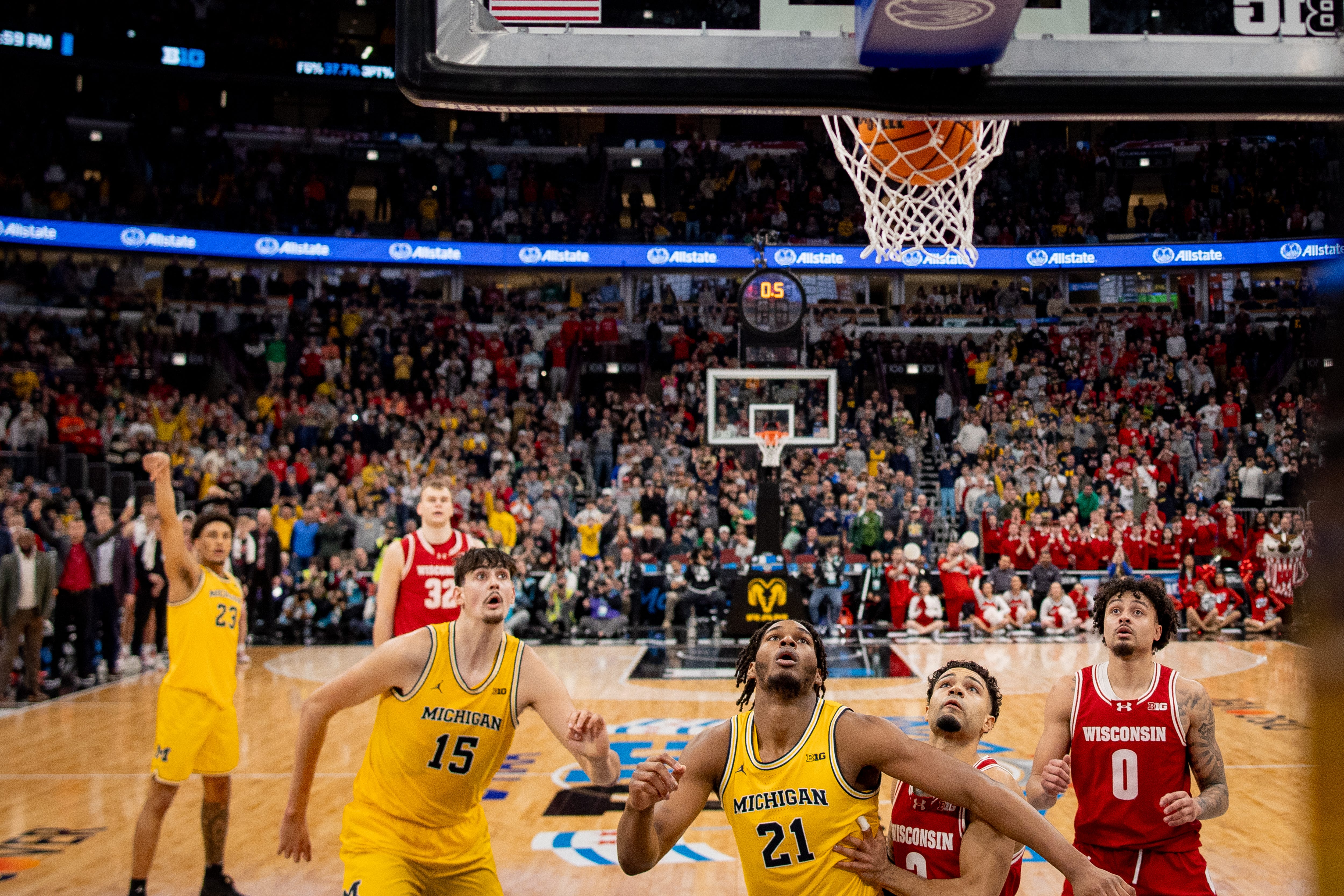
The second frame arrives a split second later.
The question has been answered.
The ball is already through the net. The clock is nearly empty. And for the first time in the sequence you can see it on the players’ faces. In the front row are Mara and Moretz, along with a few Badgers. Realization beginning to spread across the court. In the backcourt stands Yaxel, almost perfectly still, like a statue. A slightly stunned, slightly heroic statue. Très calme4.
This angle comes from a second camera I mounted directly on the basket before the game, triggered remotely by PocketWizard plus III radios from the floor. In a way, it allowed me to be in two places at once. Which, as any photographer will tell you, is the dream and the permanent frustration of the job.
Remote cameras are a small act of faith.
They have to be installed hours before tip-off. The framing must be chosen in advance. The lens as well. In this case a Canon RF 35mm. Focus settings too. Once the game starts, nothing can be adjusted.
You make a few definitive choices and hope the basketball gods cooperate.
I actually went with the riskiest option possible. The framing assumed the play would come toward that side of the rim. If the final possession had unfolded on the other end of the basket, the camera would have captured absolutely nothing:
A very elegant photograph of empty hardwood. Magnifique5.
Sometimes photography is preparation.
Sometimes it is instinct.
And sometimes it is simply hope.
The advantage of this position, when it works, is perspective. Still wide enough to show the arena and the scale of the moment, but close enough to read faces.
And faces are where the story lives.
Here the rim and net anchor the top of the frame, the ball just finishing its fall. Beneath it, the players form a loose semicircle, all eyes still lifted upward, as if their brains need one extra fraction of a second to confirm what just happened.
In classical painting, artists often built scenes around this kind of suspended instant. The action technically finished, but the human reaction still catching up.
The structure again follows the same simple principles. A clear focal point. The net and ball acting as the visual center. The players’ gazes guiding the viewer upward. The crowd forming a dense emotional backdrop. Even the clock quietly participates, reminding you just how little time remained.
But the real subject here is expression.
The wide lens still gives you the scale of the arena, yet the distance is short enough to read the emotion on each face. Anticipation turning into certainty. A split second where disbelief, hope, and realization all exist together.
The shot is already made.
But the moment is still landing.
The French instinctively make things sound poetic even when describing something that lasted about 0.8 seconds. A Midwesterner would probably say “two quick things that happened there.”
In theory it refers to cathedrals, palaces, and sweeping historical moments. In practice, in Chicago it can also describe the view when the sun hits Chicago River just right, the skyline glows, and someone nearby is still holding a neon-green beer from St. Patrick's Day at 10:30 in the morning. Which, frankly, is its own kind of grandeur.
The feeling you get when the river turns green for Chicago St. Patrick's Day Parade and you realize the entire city has already committed to the chaos.
Used here to describe the heroic stillness of someone who just hit a game-winning three. French philosophers might call this composure. In Big Ten country it’s more commonly known as opposite to B-pone.
In this case it describes the hypothetical artistic beauty of a photograph capturing absolutely nothing if the play had gone the other direction. Midwestern equivalent: “well… that didn’t work.”